Two Different Sales: Why Mainframe and Temenos Modernization Need Different Stories
If you're selling 'AI for legacy modernization' the same way to a bank running a 30-year COBOL core and one running a packaged platform, you're losing both deals
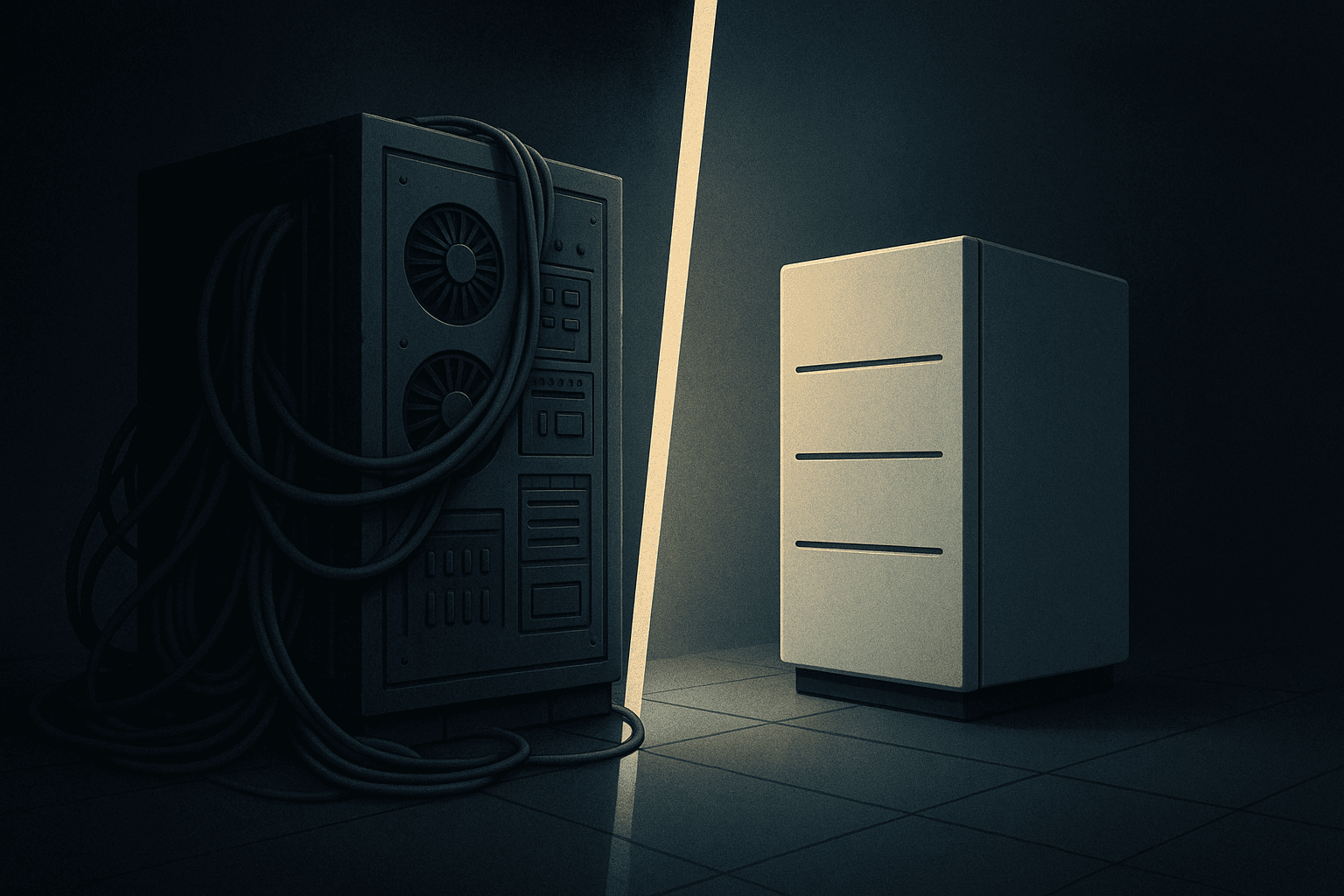
Walk into a Tier-1 bank running a 30-year COBOL core and pitch "AI for legacy modernization." Then walk into a Tier-2 bank running a packaged core platform and use the exact same pitch. You'll lose both rooms.
Not because the pitch is wrong. Because it's the wrong pitch for the room. These two banks have the same word for their problem - "modernization" - and almost nothing else in common. Different bottleneck. Different team. Different artifacts available. Different definition of "done." Different procurement path. Same word.
The market has been conflating them for a decade. Most vendors still do. Here's the divergence, what each side actually needs, and how to tell which conversation you're in within the first ten minutes.
The bottleneck is in different places
Start with what's available to the team on day one of a modernization program.
A bank running its core on a mainframe - typically COBOL, RPG, JCL, with PL/I or Assembler in the corners - owns the source code. Every batch job, every CICS transaction, every data definition, every business rule sits on disk inside the bank's perimeter. The code is the truth. The retirement of the engineers who wrote it is a problem; the absence of the code is not. The bottleneck is understanding. What does this 12,000-line program actually do? Which programs depend on this copybook? What happens if I change this field? Where is this rule enforced and where is it bypassed? The artifact you need to produce is a deterministic, queryable model of a system whose authors are mostly gone.
A bank running its core on a packaged platform - Temenos, Mambu, Oracle FLEXCUBE, or similar - owns almost none of the source. What it owns is the bank-side customizations: Java wrappers, parameterizations, configuration tables, API integration code, the SOAP envelopes that wrap calls to the closed product. The core's behavior is inferred, not read. The bottleneck is not "what does this code do" - the customizations are tractable and the platform behavior is documented. The bottleneck is data: how do I move customer accounts, instruments, positions, and history out of this platform's customized state into the next platform's customized state without losing the audit trail, the regulatory reporting, or the customer experience?
,[object Object], If the customer's hardest unsolved problem is "I don't know what the system does," you're on the mainframe side of the market. If the customer's hardest unsolved problem is "I don't know how to move my data into the target without it breaking on arrival," you're on the packaged-core side. Both customers will use the word "modernization." They're not buying the same thing.
The team in the room is different
The mainframe-modernization conversation happens with a different audience than the packaged-core migration conversation.
On the mainframe side the room contains the application owners of the legacy core, the senior architects who maintain the dependency map in their heads, and - increasingly - the COO or risk officer whose name will be on the sign-off when something migrates. The conversation centres on whether the bank can credibly explain its own system to itself. A senior modernization executive at a Tier-1 European bank framed it cleanly when we asked what blocks them from using AI on legacy:
"It gives you something, it looks great, it probably even works, but you don't really know why and how because it's a black box in there that becomes very difficult for me to sign off." - a senior modernization executive at a Tier-1 European bank
That's not a sentence a CTO running a packaged-core migration says. The packaged-core migration has a different room. The architects are platform specialists. The team owns the customizations and the data layer; the core itself is a vendor product. The bottleneck conversation is with the migration lead - usually a delivery executive responsible for moving N entities, M instruments, and a multi-year history - and with the systems integrator who built the customizations originally.
The mainframe-side buyer is asking "can I trust what's in there?" The packaged-core buyer is asking "can I move what's in there?" Same word at the top of the deck, two completely different rooms underneath.
The artifact each side needs is different
A mainframe-modernization engagement produces, fundamentally, a deterministic model of an unknown system. Dependency graphs across COBOL, RPG, JCL, and the integration layer. Field-level lineage across program boundaries. Business rules extracted from conditional expressions with full source provenance. Process flows anchored to CICS transactions and batch entry points. Architecture views the bank can hand to a regulator. The artifact's job is to make a system legible - to the engineers who will change it, to the architects who will sign off, to the regulator who will ask why a change was safe.
A packaged-core migration engagement produces, fundamentally, a data-and-customization transfer plan. Field-level mapping from the source platform's customized state to the target platform's expected schema. ETL transforms with validation gates. Customization equivalence - this Java wrapper around the source product needs to become this configuration in the target product. The artifact's job is to make a move survivable.
These are different artifacts. They are produced differently. They are validated differently. They are owned by different people inside the bank. A vendor that ships one and calls it the other will not land.
,[object Object], A vendor strong on mainframe-side analysis walks into a Temenos migration and pitches dependency graphs. The room hears "you understand the inside of our packaged product?" No - that's a closed product. The room walks. A vendor strong on data-ETL walks into a mainframe room and pitches transformation pipelines. The room hears "you're going to convert our COBOL to Java?" That's the conversion narrative the hyperscalers have commoditized - the room walks.
The confidence ceiling is different
When you analyze a mainframe estate, the source code is the truth and every assertion can be traced back to a line of code. The confidence ceiling is high. You can say with provable accuracy: this program calls this program with these data, under these conditions, producing these effects, in this sequence. That's a defensible artifact.
When you analyze the bank-side customizations of a packaged platform, the source code is also visible - but only for the customizations. The behavior of the closed product behind the API is inferred from how the bank calls it. We have direct experience of this on a current engagement:
"When I'm looking at the project on the Temenos-based engagement, it's a lot harder - like the know-how. I know everything happening on the bank side, all the customizations, all the Java on top, parameterizations. But how exactly the calculation is happening inside the packaged product - my only access to that is either them telling me or sending me documentation. What happens behind that is inferred." - internal Tweezr engagement note
That inference is honest work, but it's a different work product than mainframe analysis. The confidence is lower at the boundary. The artifact has to disclose where it ends - "here's what we can prove from the customization code; here's what we're inferring from how the bank calls the product; here's where you need the vendor or the SME." The packaged-core engagement produces a boundary-aware model, not a deterministic one.
A vendor that pretends the two engagements have the same confidence profile loses credibility the first time the bank's architects test it.
The procurement path is different
Even the way the deal gets bought is different.
A mainframe-modernization initiative typically sits inside the bank's legacy maintenance organization, which reports up through the CIO or the head of group technology. The procurement path passes through application owners, then through the operational-risk function (because the legacy core is operationally critical), then through the sign-off chain that owns the production change calendar. Cycle times are measured in quarters; champion development matters more than feature velocity; the buying committee includes a senior operational executive whose personal fiduciary risk is on the line for sign-off.
A packaged-core migration sits inside the bank's transformation organization, which often reports directly to the COO or to a transformation executive at the board level. The procurement path includes the migration program lead, the systems integrator that owns the implementation, and - crucially - the platform vendor whose product is being migrated to. Cycle times are paced by the migration plan; SI relationships matter more than direct seller relationships; the buying committee weights heavily toward delivery executives accountable for the cutover date.
A seller working both segments needs two motions, not one. The collateral that closes mainframe deals - investigation-grade evidence, regulator-defensible artifacts, blast-radius reports - does not close packaged-core deals. The collateral that closes packaged-core deals - data-ETL pipelines, customization equivalence packages, target-state validation - does not close mainframe deals.
How to tell which conversation you're in within ten minutes
Three diagnostic questions, in order:
1. "What does the source-of-truth look like for the system you're trying to change?" Mainframe side: "We have all the code. We just don't know what it does." Packaged-core side: "We have our customizations and integrations. The core itself is a vendor product."
2. "Where does your current modernization program get stuck?" Mainframe side: "Understanding cross-program dependencies before we change anything." Packaged-core side: "Moving customer and instrument data into the target platform without breaking the customizations."
3. "Who owns the sign-off on a production change to this system?" Mainframe side: A senior operational executive - often the COO or the head of operational risk - with personal fiduciary accountability and a head-of-compliance counter-signature. Packaged-core side: The migration program lead, the SI, and the target platform vendor, with the COO entering only at major cutover gates.
If the answers cluster on the mainframe side, the pitch is investigation-grade understanding for safe change. If they cluster on the packaged-core side, the pitch is data-and-customization transfer with validation against the target. Mixing them wastes everybody's first hour.
What this means for the modernization market in 2026
Most analyst landscapes for "legacy modernization" still draw one box. The vendors in it have wildly different capabilities and the buyers in it have wildly different problems. As the market matures, that box will split - and the vendors that already operate two distinct motions will be positioned for both.
The mainframe side will consolidate around investigation-first platforms: deterministic system intelligence as the prerequisite for any AI-assisted change. The packaged-core side will consolidate around boundary-aware migration platforms: customization mapping, field-level data lineage, and target-state validation. There will be vendors in both. The vendors who try to cover both with the same pitch will keep losing both rooms.
,[object Object], "Legacy modernization" is two markets sharing a name. The bottleneck, the team, the artifact, the confidence ceiling, and the procurement path are different on each side. A seller who diagnoses the right side in the first ten minutes earns a second meeting. A seller who treats the word as the segment loses both deals - and so does the bank, which buys the wrong artifact for the actual problem.
Frequently Asked Questions
How do I tell quickly whether a bank is on the mainframe side or the packaged-core side?
The fastest tell is the source-of-truth question: do they have the full source code of the system they're trying to change? If yes, they're on the mainframe side, and their bottleneck is understanding. If they have only customizations and integration code against a packaged product, they're on the packaged-core side, and their bottleneck is data transfer with customization equivalence.
Can the same intelligence platform serve both segments?
Yes, but with different value props and different output artifacts. On the mainframe side the platform's job is to produce a deterministic model of an unknown system - dependency graphs, business rules, process flows, blast radius. On the packaged-core side the platform's job is to produce a data-and-customization transfer plan - field-level mapping, ETL transforms, customization equivalence, target-state validation. Same underlying capability set; different deliverable.
Does the packaged-core side need deterministic analysis at all?
It needs boundary-aware analysis. The bank-side customizations can be analyzed deterministically - the source is available, the call patterns are traceable. The closed product's internal behavior cannot; it has to be inferred from how the bank uses it. A credible vendor on this side draws the line explicitly and discloses where confidence drops from "provable" to "inferred."
Which segment is growing faster?
Both are growing, driven by different forces. Mainframe modernization is paced by COBOL workforce retirement, ECB-style regulator pressure on operational resilience, and the cost economics of running a 30-year core. Packaged-core migration is paced by vendor end-of-life roadmaps, M&A consolidation (banks inheriting multiple cores after acquisitions), and target-platform investment cycles. They're not substitutes - most large banks have both problems on their roadmap simultaneously.
Where does the hyperscaler "COBOL-to-Java" narrative fit?
That narrative collapses both segments into a conversion pitch - "we'll translate your legacy to a modern stack." It addresses neither bottleneck directly. On the mainframe side it skips the understanding phase entirely (you can't safely convert what you don't understand). On the packaged-core side it solves the wrong problem (the bottleneck isn't conversion, it's data transfer into a different vendor's product). The conversion narrative is being commoditized; the investigation and transfer narratives are where the durable value sits.
Tweezr operates two distinct motions for the two distinct sides of the legacy modernization market. If you're scoping a program and not sure which conversation you're in, see how the deterministic blueprint works or book a discovery session to map your specific bottleneck.
Related Posts

Discovery Is the Migration
The industry treats discovery as Phase 1. That is the mistake that kills 70% of modernization programs. Discovery is not the prelude to the work. It is the work.
The Retirement Cliff: When Your COBOL Lead Walks Out, Your Risk Doesn't
In every bank we walk into, there is one engineer who knows where the bodies are buried. When they retire, the bank inherits a system nobody can change safely. The answer is not to replace the person. It is to capture what they know - before the cliff.
Citations or It Didn't Happen
In a regulated bank, an AI answer without sources is wishful thinking. The single property that turns AI output from a chatbot guess into an auditable artifact is verifiable grounding - every claim, one click back to the line of code it came from.